
The Bill Comes Due: Understanding Independence's Debt
Debt isn't automatically bad, especially for a city. For example, if Independence needs to build a wastewater treatment facility that will serve the community for decades, it may not make sense—or even be possible—to save enough cash to pay for the entire project before beginning construction. Borrowing allows the cost of a long-lived asset to be spread over the years in which people will benefit from it.
Most of us understand this as it applies in our own lives. Having a car payment or a mortgage doesn't automatically mean you've made a bad financial decision. What matters is what you borrowed the money for, how much you owe, whether you can afford the payments, how long you'll be making them and what those payments mean for the rest of your household budget.
That's a much more useful way to look at the City's debt, too.
We don't have one big pile of debt
According to the City's third-quarter financial report for FY2025–26, Independence has thirteen listed outstanding debt obligations. They are tied to a variety of things, including water, wastewater, MINET, the Civic Center, water rights, the Museum and Independence Landing.
It's tempting to add all of those balances together and use the biggest number possible when talking about City debt. But that doesn't tell residents the whole story.
Water debt isn't the same thing as Civic Center debt. Wastewater debt isn't the same thing as MINET debt. Different obligations have different revenue sources supporting them, different interest rates, different repayment schedules and different purposes. Some are associated with systems that generate their own revenue. Others have broader implications for City finances.
So yes, the total amount we owe matters, but understanding what makes up that total matters just as much.
There is some genuinely good news in that picture. Six of the City's thirteen listed obligations are scheduled to be paid off within five years. The City's Q3 report also says the two Water Fund obligations are budgeted for early payoff in FY2026–27, which is expected to save approximately $110,000 in interest. The 2017 MINET obligation is scheduled to be paid off in FY2026–27, and the Water Rights loan has three payments remaining.
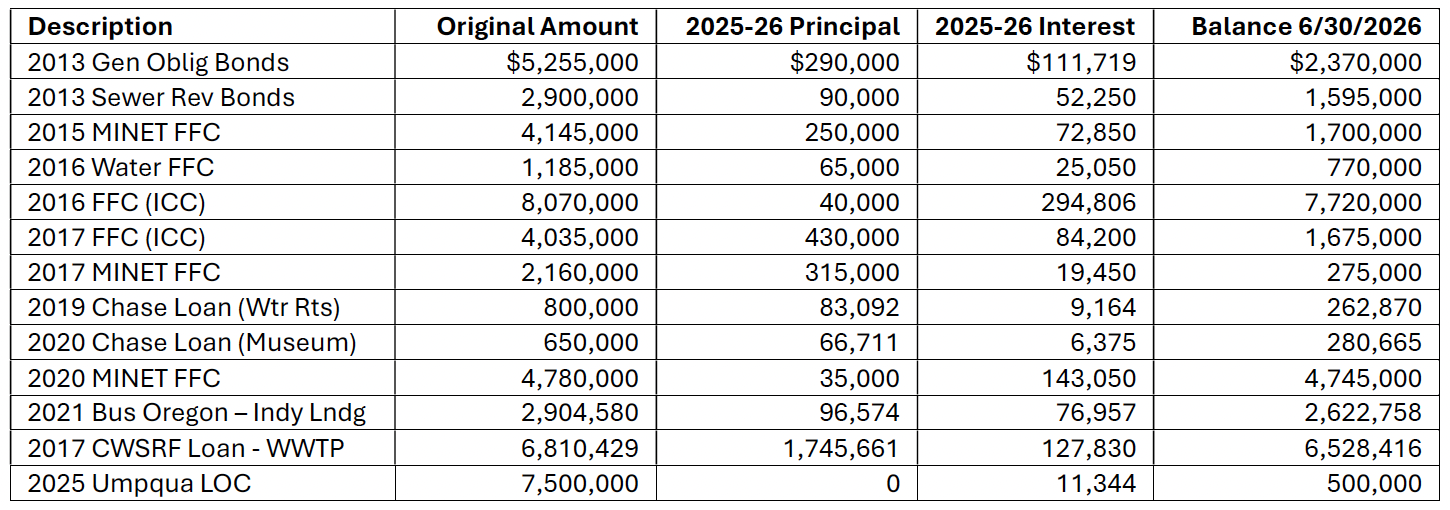
This table provides a summary of outstanding debt, including original issue amount, principal, and interest payment for the 2025-26 fiscal year, and balance outstanding as of the end of this fiscal year. ICC = Independence Civic Center. WWTP = Wastewater Treatment Plant.
S&P's 2026 analysis gives us another way to look at it. It reports that approximately 66% of the City's direct debt is scheduled to amortize within ten years and notes that Independence does not anticipate issuing additional debt during the next three fiscal years.
Those are positive developments. But I don't want to turn them into a victory lap, because we still have significant financial challenges ahead of us.
This didn't happen overnight
One reason I think it's important to put our current debt into historical context is that it would be easy to look at Independence's financial challenges today and assume or claim that something suddenly went wrong in the last few years. The record tells a much longer story.
In 2017, S&P assessed Independence's debt and contingent-liability position as "very weak." At the time, debt service consumed 28.4% of governmental-fund expenditures, and S&P calculated net direct debt at 388.8% of governmental-fund revenue. It expected the City's debt profile to remain weak into the following decade because of the amount of debt relative to revenues and the pace at which it was being repaid.
That same review also identified the complicated financial relationships we discussed in my last post: utility funds supporting the General Fund, Urban Renewal relying on pooled City cash and MINET creating additional financial exposure for the City.
This is why I think debt and utility transfers need to be understood together. Neither tells the whole story on its own.
Over a period of years, Independence was investing in infrastructure and facilities, pursuing grants, borrowing for long-lived assets, supporting community services and moving money among funds to help make the overall financial structure work. Many individual decisions undoubtedly had a reasonable explanation at the time. The problem is that eventually we have to look at the cumulative effect of all of them.
We don't just inherit the things that were built. We inherit the obligations attached to them.
MINET and Urban Renewal make the picture even more complicated
MINET is probably worthy of its own history lesson, and I'm not going to attempt to tell that entire story here. But it does matter to understanding the City's debt and interfund relationships.
S&P's 2017 review specifically identified MINET as a financial risk because the telecommunications utility had not generated sufficient revenue to fully support obligations that had been expected to be paid by the enterprise. The City had used resources from other funds to help meet those obligations, including support involving the Water Fund.
Today, the City's debt report lists multiple MINET obligations. That can look like several unrelated borrowing decisions, but the Q3 report explains that they trace back to a single original MINET bond. Portions were refinanced in 2015, 2017 and 2020 to take advantage of favorable interest rates and reduce borrowing costs, which is why they now appear as separate obligations for accounting purposes.
At the same time, MINET owes money back to the City. Thankfully, MINET has been making their scheduled payments and are in a strong position to continue making payments.
Urban Renewal owes money as well. As of June 30, 2026, the City's Q3 report showed approximately $3.78 million owed by the Urban Renewal Agency to the General Fund, with repayment scheduled through FY2034–35. Urban Renewal also had smaller interfund obligations to several other City funds.
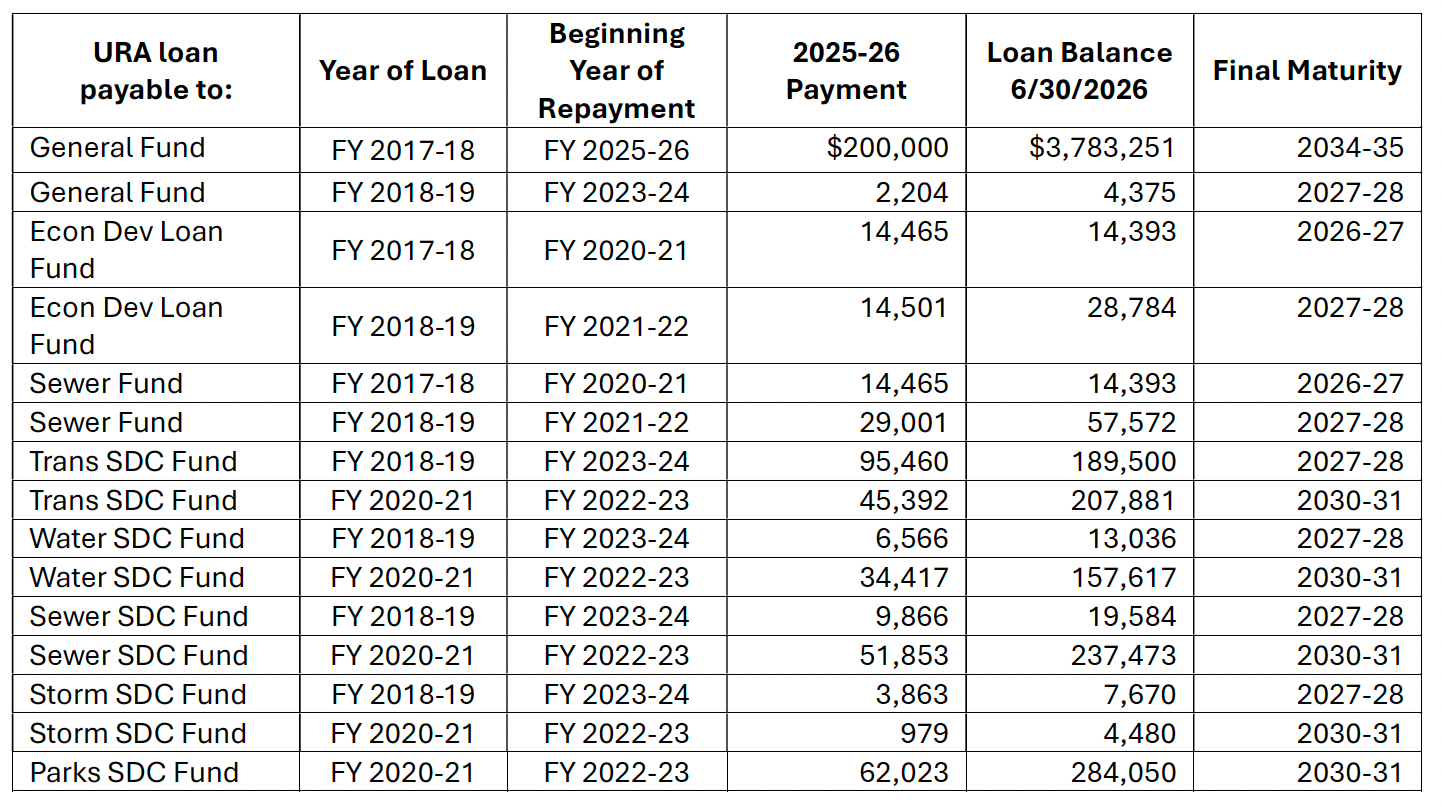
This table shows the annual payments due on each loan, the outstanding amounts at the end of the 2025-26 fiscal year, and the year each loan will be paid off.
This is where municipal accounting starts to get complicated. On the surface some of these issues can look pretty straightforward. But once you start following the money - what is owed, who owes it, which fund it belongs to, when it will actually be available, and what restrictions come with it - the simple answers tend to disappear pretty quickly. That’s why I’m cautions when anyone suggests there’s an easy fix.
The easiest way I know to explain it is this: if someone owes you $10,000 and promises to repay you over the next eight years, that $10,000 is an asset on your personal balance sheet. But you don't have $10,000 in your checking account today because they haven’t given you the payment yet.
That distinction has become very important to Independence.
Money owed to us isn't the same as money available to us
The City's reported General Fund balance has included money owed back to the General Fund through these interfund relationships. S&P's 2026 review took a much more conservative view when evaluating how much money Independence actually has readily available.
After recognizing the large interfund loan receivable as nonspendable, S&P calculated available reserves of roughly $1.3 million. When it further excluded the Urban Renewal receivable, S&P calculated available General Fund reserves at approximately $657,000, or 11.5% of revenue.
That's where our current financial picture gets uncomfortable.
S&P affirmed Independence's A credit rating in 2026, compared with the A- rating reflected in its 2017 assessment. It also recognized recent, significant improvements in the City's financial management, including long-term planning, quarterly reporting, reducing fixed costs and disentangling interfund dependencies. Those things matter, and I'm proud that we're moving in that direction.
But S&P also changed our outlook from stable to negative because our available reserves have declined. It specifically warned that the rating could be lowered if our fiscal recovery efforts don't restore reserves and liquidity to more sustainable levels.
So, this isn't a victory lap, but we are moving in the right direction. We're making progress in some areas while facing significant risk in others. And that's exactly why I think we need to resist overly simple descriptions of the problem.
Debt isn't really the biggest warning sign
The fact that Independence carries debt isn't, by itself, what concerns me most.
Think again about a household. You might have a mortgage, a car payment and perhaps a home-improvement loan. Those obligations may all be perfectly manageable if your income comfortably covers your monthly expenses and you have adequate emergency savings.
Now imagine that your monthly household expenses are consistently higher than your monthly income and you're dipping into your savings to make up the difference.
The mortgage didn't suddenly become irresponsible. But the combination of your existing obligations, declining savings and monthly deficit puts you in a much more vulnerable position. That's closer to where Independence finds itself today.
We have long-term obligations that need to be paid. We have utility infrastructure that needs continued investment. We have reserves that need to be rebuilt. At the same time, the recurring revenues available to our General Fund have not been keeping pace with the recurring cost of the services supported by it.
Paying off some of our debt over the next several years will help. However, it doesn't, by itself, fix that underlying imbalance.
We inherited both the assets and the obligations
For nearly a decade, independent financial assessments have been telling a remarkably consistent story about Independence: significant debt, complicated interfund relationships, limited financial flexibility and reliance on resources from other funds to support ongoing operations.
That's history we should learn from. And it's particularly relevant now because there is an active debate in our community about whether some of the financial practices we're moving away from should again play a larger role in managing the City's finances.
Interfund loans and transfers are legitimate municipal tools when used properly. But Independence's experience also demonstrates what can happen when temporary tools become structural dependencies.
It's also important to acknowledge that these financial practices didn't simply happen on their own. Every City Manager brings their own approach to managing an organization, and previous managers had both the authority and responsibility to recommend the financial and operational practices they believed were appropriate at the time. Greg Ellis (CM from 2000-2010) and David Clyne (CM from 2010 to 2018) made decisions that included taking on debt and increasingly relying on transfers, loans and other relationships between City funds. The chart accompanying this post helps show when many of those obligations and practices were put into place and the years under which they occurred.
Our current City Manager, with the support of Council, has made a different choice. We do not believe continuing to build on a financial structure that depends on one fund supporting another is sustainable, particularly when our utility systems have significant obligations of their own. So, we've been working to unwind those dependencies rather than add to them. That has made our financial situation more visible—and, frankly, more painful to address—but I believe it's better to confront the true cost of our services and obligations now than continue down a path that future councils and residents would eventually have to reckon with.
In 2017, S&P was warning about the complexity of those relationships and specifically noted that disentangling them would be difficult. In 2026, S&P is specifically recognizing the City's work to disentangle those same kinds of dependencies as an improvement in our financial management.
I don't think we should ignore that lesson. We can't simply go back to the way we were because the old system made some of the numbers look better. If one fund can't support itself without regularly relying on another, eventually the underlying problem is going to surface somewhere.
That's why I keep coming back to the same question: Are we actually solving the problem, or are we moving it somewhere else?
I want us to solve it.
It's time to turn the page
I've spent a lot of time over the past several months talking about how Independence got here. I know it hasn't always been the most uplifting story to tell, and I know some people are ready to stop hearing about the history and start hearing about solutions. I am, too.
But I think understanding the history is necessary because we can't have a serious conversation about solutions until we're clear about the problem we're trying to solve. At this point, I think we have a much clearer picture.
Our General Fund's recurring revenues have not been sufficient to support the recurring cost of the services we've been providing. For years, complicated interfund relationships helped make that imbalance less visible. Our utility systems have substantial needs of their own and need their revenues to operate, maintain and eventually replace the infrastructure we all depend on. We have debt and other financial obligations accumulated over many years that we still have to honor. And our available reserves are thinner than they should be.
None of that means Independence is doomed. But it means we have work to do. And that's where I want this conversation to go next.
I don't believe there's one magic solution waiting for someone clever enough to discover it. I think getting to a financially sustainable place will require us to look seriously at all the options in front of us: expenses, service delivery, facilities, City-owned property, partnerships, economic development, responsible growth, grants and outside investment, and revenue.
I also want to look seriously at potential ideas, regardless of where they come from. But being open to an idea doesn't mean we have to keep circling back to it after we've done the work and determined it isn't feasible. Sometimes an idea that sounds straightforward runs into financial, legal or operational realities that aren't obvious from the outside. Our responsibility is to explain those realities as clearly as we can, but at some point, we also have to be willing to say, "We've looked at this. It doesn't get us where we need to go." Then we need to move on and put our energy into ideas that actually can.
The test we use is pretty straightforward. What does an idea actually save? What does it cost to implement? Is the impact temporary or ongoing? What changes for residents? What happens five years from now? And, most importantly, does it actually help solve the structural problem?
Some answers may surprise us. Some will involve tradeoffs. I suspect the eventual path forward will be a combination of many smaller things rather than one dramatic solution.
The point isn't to prove that we've always done everything right. The point is to understand where we are, learn from how we got here and make better decisions going forward.
We've spent enough time looking backward. In the next chapter, let's talk about how we get out. I’m looking forward to turning the page and focusing on how we create a financially sustainable future for our community.